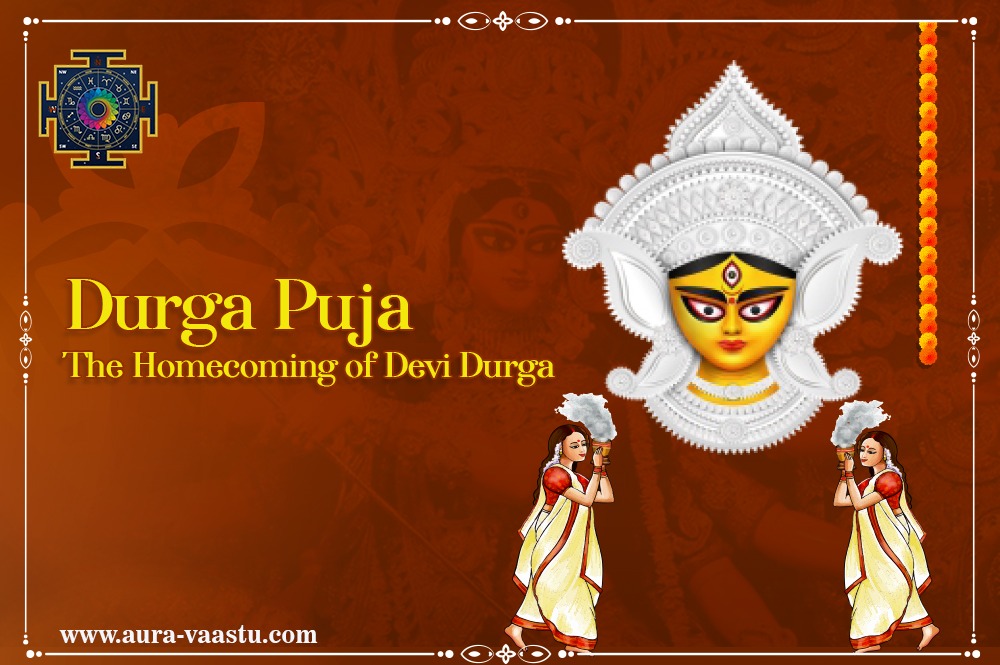
Durga Puja: The Homecoming of Devi Durga
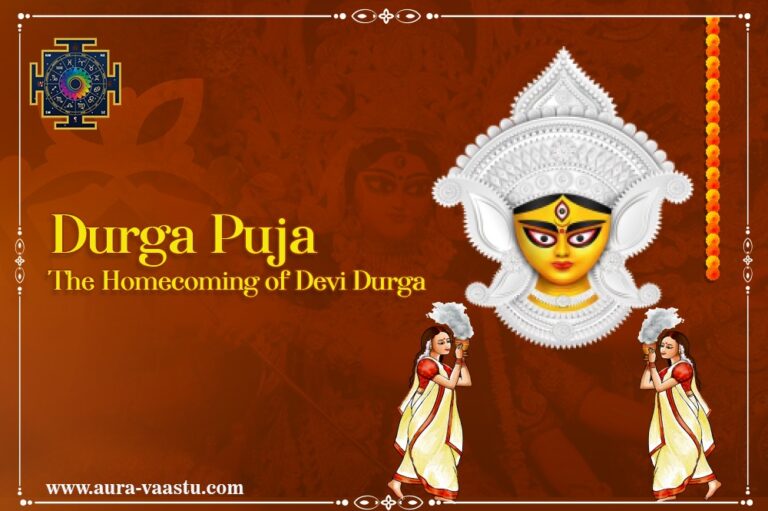
Durga, which means invincible in Sanskrit, represents the sacred feminine power. In Bengali, the name implies the power which can save one from utmost suffering. Devi Durga is the personification of shakti, and is known to be mother of this universe. While she is the force which nurtures and dissolves forms, she also ignites the seven lotuses related to the centre of awareness in the spiritual body. Goddess Durga, the consort of Lord Shiva, is depicted having ten arms, carrying deadly weapons and riding a lion for which she is named as Simhavahini.
Traditional Tale of the Fight Between Ma Durga and Mahishashur
According to legend, a demon named Mahishashur had established a rule of tyranny in the Heavens, the Earth and the Netherworld. Lord Brahma had granted a boon to Mahishashur that none of the men or deities will be able to destroy him. As a result, he turned so mighty that he could not be subdued by any of the divine powers. Hence, the divine forces of the trinity created Mahadevi Durga to teach Mahish a lesson. The radiant goddess, who had ten arms, was blessed with the finest weapons by different gods and a lion by Himalaya to ride on. Devi Durga, armed with all the divine powers, attacked the buffalo demon Mahishashur. Thus, started the nine-day long battle which finally ended with the death of the demon. The victory of Ma Durga reinforces the fact that however bad the situation is, good always wins over evil. It is also symbolic of the final conflict of a man’s spiritual urge with his lower passions. The end of this struggle ultimately leads a man to the supreme level of consciousness.
Devi Durga is a Symbol of an Unified Divine Power
As Goddess Durga arose from the unified powers of all the important Gods, she manifested their principles and adopted their weapons. Durga united the Gods and showed them how to win the battle against evil in a collective manner. Durga is thus the epitome of unity. In Durga Puja, Goddess Durga is depicted as the mother of Ganesha, Kartikeya, Lakshmi and Saraswati. These four deities actually symbolize four different powers essential in the creation of a particular spiritual state. Ganesha is the deity for physical power; Kartikeya represents celibacy and courage; Lakshmi stands for business and wealth; Saraswati embodies wisdom and purity. Therefore, these deities collectively represent physical energy for industrial and agricultural workers; chivalry for soldiers; riches for businessmen and knowledge for the intellectuals.
Sharadiya Utsav
Durga Puja is a festival in which the devotees invoke Devi Durga to seek blessings from her for a stronger and determined character. Perhaps, the best place to witness the grandeur and intense fervor of the festival is in West Bengal. The six-day long festival starts with Mahalaya and ends on Vijay Dashami. It is believed that Durga Puja is the time of the year when Goddess Durga visits earth, her ancestral home, with her children and stays for six days after which she leaves for Kailash for a reunion with Lord Shiva. As this festival falls in Autumn so it is also known as ‘Sharadiya Utsav’. It usually falls in Ashshin, the sixth month, according to the Bengali calendar. It may however be celebrated in the month of Kartik in case of a shift in the lunar cycle in relation to the solar months. The right time for celebrating Durga Puja in the conventional way is in the month of Spring (Basanta Ritu) but we celebrate the festival in Autumn (Hemanta Ritu). This is why Durga Puja is also known as Akal Bodhon or untimely invocation. According to the Indian mythology of Ramayana, Lord Rama invoked Devi Durga by performing the Chandi Puja before attacking Ravana who had abducted Sita, his wife. According to Hindu mythology, it was not the right time to worship any god because it was the time of ‘Dakshinayan’ when the gods and goddesses took rest. Lord Rama awakened Devi Durga untimely in the month of Ashshin and hence the name, Akal Bodhon.
Mahalaya: Beginning of the Festivities
This glorious festival commences from the day of Mahalaya, the day which marks the end of Pitri Paksha and the beginning of Devi Paksha. On this auspicious day, devotees invoke the Goddess to descend on earth for them, by chanting mantras or singing devotional songs. Mahalaya is considered to be the period of time when the Goddess killed all the evil demons or asuras. Mahalaya makes way for the most celebrated festival of the year in West Bengal, Durga Puja.
This day has an important religious importance. The artisans wake up in the wee hours of morning and paint the magnificent eyes of the idol of Devi Durga. This process is known as ‘Chokkhu Daan’(offering the eyes). Bengalis wake up early and do the Chandi recital. An interesting tradition of Mahalaya is its association with a radio program called, “Mahishashur Mardini”. The entire Bengal wakes up at pre-dawn to catch up this All India Radio program.
Maha Shashthi: The Arrival of Ma Durga
Maha Shashthi which falls on the sixth day of Devi Paksha marks the beginning of Durga Puja in a formal way in West Bengal. The festival formally kicks off from Maha Shashthi with the observance of important rituals of Kalparambho (commencement of puja), Bodhon (unveiling the face of Ma Durga’s idol), Amantran (invitation to Ma Durga) and Adhivas (sanctification of the area of worship). The face of the idol of Ma Durga is unveiled as a part of Bodhon rituals. It is believed that on this day, Ma Uma, the consort of Lord Shiva, visits her father’s home with her four children- Ganesha, Kartikeya, Lakshmi and Saraswati. As a ritual, women install the Durga ghat before Ma Durga’s idol. This is a kind of welcome gesture to Uma, on her arrival at her father’s house. The atmosphere is filled with the rhythmic beats of drum (dhaak) announcing the arrival of Ma Durga. Many artists are seen busy giving the finishing strokes to the decorations of the pandals on Maha Shashthi. The garment shops are crowded as the people do their last minute shopping. It is an old tradition to buy new clothes on Durga Puja and everyone enjoys doing it for this occasion. As evening sets, the festive mood is heightened with the lanes and roads decorated with bright lights and colours.
Maha Saptami: The Beginning of Rituals
Maha Saptami which follows Maha Shashthi remains one of the significant days of the six-day fiesta. This is the day when the ritual of infusing life into Devi Durga’s idol (pran prathistha) is done. A tender banana plant is bathed and dressed in a white sari with red border after which vermillion is applied on it. This plant which is known as ‘Kola bou’ or ‘Navapatrika’ is then carried by the priest to the puja pandal in a splendid procession. ‘Kola bou’, who is believed to be the consort of Lord Ganesha, is installed beside Him and worshipped for good fortune. Nine plants representing the nine forms of Devi Durga are also worshipped. These nine plants include the banana plant (kola gaach), turmeric plant (halud gaach), colacassia plant (kochu gaach), wood apple tree (bel gaach), jayanti tree (jayanti gaach), arum plant (maan kochu gaach), pomegranate tree (dalim gaach), Ashoka tree and rice plant (dhaan gaach). Banana plant symbolizes Goddess Brahmani, turmeric plant symbolizes Devi Durga, colacassia plant stands for Goddess Kalika, wood apple symbolizes Goddess Shiva, Jayanti is for Koumari, arum symbolizes Chamunda, pomegranate is for Raktadantika, Ashoka represents Shokrahita and rice plant represents Goddess Lakshmi. Another significant ritual of this day is to place a brass pot which is filled with water from the pond or river and place at Devi Durga’s feet. This pious pot epitomizes Ma Durga’s feet.
Maha Ashtami: The Day When Ma Durga is Invoked as a Young Girl
The next day is the most awaited day for all the people as they get ready to make an offering of flowers to the deity (pushpanjali). They recite Sanskrit hymns and offer prayers to the Goddess. Many important rituals such as worshipping Kola Bou, recitation of Chandi Path, Kumari Puja and Aarti take place on the day of Maha Asthami. Kumari Puja is one of the most interesting features of Durga Puja. Devi Durga is worshipped in several forms in this festival and one of these forms is the kumari or virgin form. It is believed that it is one of the most dynamic and powerful forms of Maha Shakti. A young girl aged between 4 to 13 years is chosen as the earthly symbol of the kumari form of Devi Durga and worshipped in front of the deity. In the ancient Hindu scriptures, Kumari puja has been described as an effective way for the evolution of divinity and purity of women in our society. The right girl for Kumari Puja is an unmarried girl who is yet to reach puberty. She should be calm, serene and possess a bright disposition. She should be free of any kind of attachment with worldly pleasures and desires.
The girls are worshipped in the various forms of the Goddess depending on their age. While a one-year-old girl is worshipped in the Sandhya mould of Devi Durga, a two-year old girl is worshipped in the Saraswati form of Devi. Tridha and Kalika forms are for a three and four-year old girl respectively. A five-year old girl is worshipped in the form of Subhaga while a six-year-old is worshipped in the Uma form of Durga. Malini and Kujjika are represented by a seven and eight-year-old girl. Kalsondarbha form of the Goddess is represented by a ten-year-old girl while the Aparajita form is represented by an eleven-year-old girl. Bhairavi and Mahalakshmi are forms for a twelve and thirteen-year-old girl. Pitnayika, Khetragya and Ambika are the forms of Durga represented by fourteen, fifteen and sixteen-year-old girl respectively. Worshipping a young girl clad in red benarasi sari, wearing flower ornaments and a tilak of red sindoor on her forehead is truly a sight to behold. While the priest chants mantras and performs the Kumari Puja, the divine form of Devi Durga comes alive in all these girls. This is the moment when we can experience the Devi Shakti in a living form right in front of us.
Sandhi Puja Ritual
The next ritual is Sandhi Puja which takes place at the juncture or Sandhikhan of Maha Asthami and Maha Navami. The last 24 minutes from Ashthami till the first 24 minutes of Navami is considered as the Sandhikhan. In Sandhi Puja, Devi Durga is worshipped in the Chamunda form which is regarded as her most wrathful form. According to legend, Durga appeared as Chamunda to kill two asuras, Chando and Mundo. The time when she slayed this notorious pair was the Sandhikhan. 108 pink lotuses are offered to Devi Durga and 108 earthen lamps are lit while performing the Sandhi Puja. The lotuses signify peace and prosperity while the lamps are lit for the well-being of all. According to legend, Lord Rama prayed to Devi Durga to seek her blessings for a win against Ravana. He made arrangements to offer 108 blue lotuses to the deity. However, unfortunately, he had only 107 lotuses. So, he decided to offer his lotus-like blue eyes to the Goddess and complete the Puja ritual. But before he could do so, Devi Durga appeared before him and blessed him. People associate the customary ritual of offering 108 lotuses to Devi Durga with this mythology.
Maha Navami: An Exciting Festive Day
Maha Navami commences right after the culmination of Sandhi Puja. Devi Durga is worshipped in the form of Mahishashur Mardini on this day of festivity. The devotees perform the puja with shodhashopachar rituals. In the afternoon, devotees enjoy the Navami Bhog. It is the sacred food offered to the deity, which is later distributed among the devotees as Prasad. The evening mood is set with many participants performing the ‘dhunuchi naach’ (a dance holding hot earthen bowls emanating incense smoke). Priests conclude the day by performing the Maha Aarti and Navami Homa in the evening.
Bijoya Dashami: The Moment to Bid Adieu
The final day of Durga puja, Bijoya Dashami, arrives when people bid farewell to Ma Durga. Married women do the Devi Baran ritual where they perform aarti of the Goddess, place betel leaves in the palms, put sweets on lips, vermillion on the idol’s forehead and take blessings from Devi Durga. Then they take part in ‘sindoor khela’ where they playfully apply vermillion on each other. Dashami is the day when Devi Durga is sent back to her heavenly abode. This ritual is known as Bisarjan. The whole process starts before the commencement of Dashami puja. A branch is first marked and cut after which it is tied to a mirror. This mirror is placed in a platter in such an angle that Devi’s reflection falls on it. The priest bathes the mirror with water and then performs the Dashami Puja. The Bisarjan ritual includes the immersion of this mirror in a platter of water while the idol is shaken. The ‘ghat puja’ also forms an integral part of the Bisarjan ritual. A brass pot is placed in a rectangular plot and four arrows with the tips tied with a red thread are placed around it. The loose ends of this thread are tied around the idol of Devi Durga. After the Dashami Puja is over, the priest asks forgiveness from the Goddess for any kind of errors committed while performing the Puja. Then, after inviting her to visit her home again, he picks up a flower from the pot, chants mantras and throws it back. He then shakes the pot and tears the thread. This is the way how Bisarjan ritual is concluded.
Devotees, with a heavy heart, arrange for a grand farewell for the deity. The idols of Devi Durga along with her children are carried in a huge procession amidst music, dance and merriment. The idols are taken to a nearby river and ceremonially immersed. The teary-eyed Bengalis offer the last prayers to their beloved Ma. The atmosphere is filled with ululations and drumbeats. After the Bisarjan, it is now time for Bijoya Dashami where people visit their friends and relatives with sweets. While the young ones touch the feet of elders and take blessings, men embrace each other, a custom known as ‘Kolakuli’, and wish each other ‘Shubho Bijaya’.
Durga Puja: A Grand Festival
Durga Puja not only has a religious significance but also has a socio-economic relevance. It is one of the greatest carnivals for the Bengalis; a celebration which is observed amidst a lot of glitz, glamour and unlimited enjoyment. Durga Puja has a special meaning for different kinds of people- for some it is a religious occasion to honour the primordial energy; for some it is the time to break free from routine life and indulge in fun ; for some it is a chance to flaunt their best look; for some it is the time to make economic gains. Whatever the intention be, Durga Puja is the time for wish fulfillment and Ma Durga makes all dreams come true.